Tell us about the job
Takes about a minute. No obligation.
The burner, the heat exchanger, and the ignition system are the components a contractor looks at first on a Monroe County furnace repair call, and the reason is straightforward. Homes in Monroe County, MO run heat about seven months a year, from October through April. A furnace cycling through that much of the year puts its real mechanical load on combustion parts: the heat exchanger flexes with every cycle, the igniter fires repeatedly, and the burner assembly takes the brunt. When a furnace fails here, the fault is almost always in those parts, not in the blower or the controls that only assist.
Half the homes in Monroe County, Missouri were built in 1976 or earlier (2020-2024 ACS 5-year). Furnaces installed into stock this old were often paired with equipment that has since been discontinued, and what a contractor finds once the heat exchanger or blower assembly is open determines whether the repair is a parts order or a longer conversation. Replacement components for older furnace models are sometimes still available, sometimes sourced as old stock, and sometimes gone from the supply chain entirely. That gap between what the house originally ran and what a supplier can deliver today is where repair cost is actually decided.
The Parts of a Furnace a Contractor Checks First
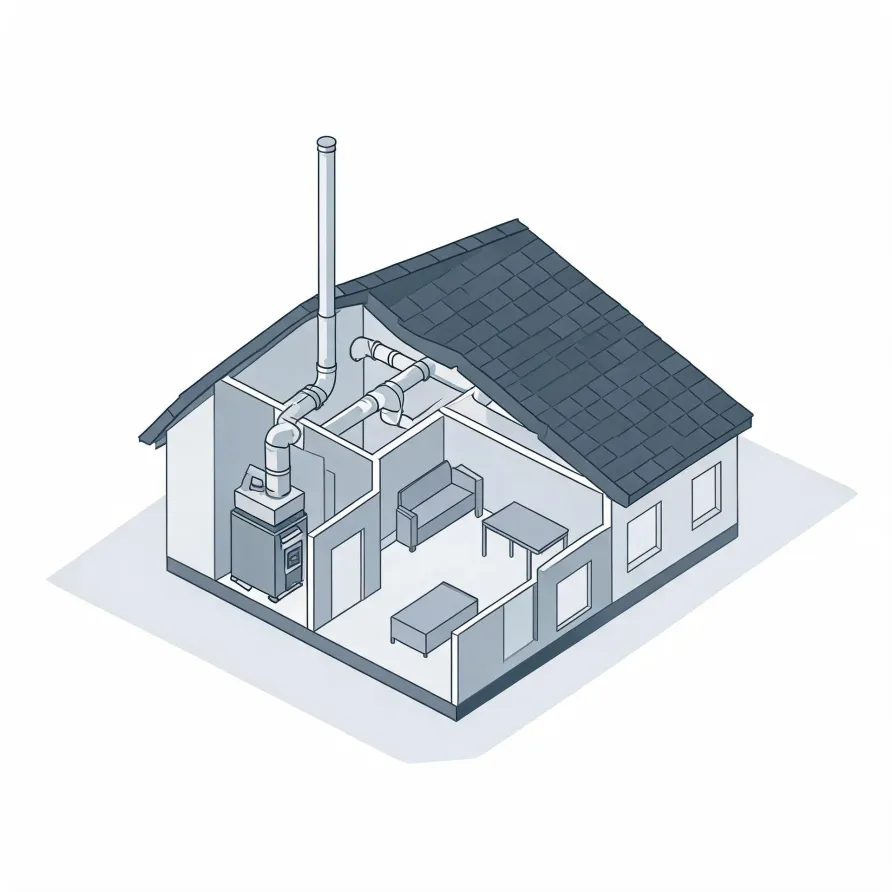
The furnace itself sits in a basement, utility closet, or mechanical room and is the piece a contractor goes to first. Inside it, the heat exchanger is the part that does the actual work of warming air, and a crack or failure there is often what brings a technician out. The burner assembly, which fires the heat exchanger, and the ignitor, which lights the burners, are two of the most common points of failure in a gas furnace.
The blower motor and blower wheel sit inside the furnace cabinet and push conditioned air through the house. Alongside them, the flue or exhaust vent runs from the furnace to the outside and carries combustion gases away. The control board ties the whole system together, reading signals from the thermostat and telling each component when to act, so a fault there can look like a problem somewhere else.
The drawing shows a typical furnace layout, and a licensed contractor determines which components apply and what condition they are in for your specific home.
Get matched in Monroe CountyMonroe County, Missouri, by the numbers
44 severe weather events were recorded in Monroe County, Missouri between 2015 and 2024.
NOAA National Centers for Environmental Information, Storm Events Database, bulk CSV export, events 2015-01-01 through 2024-12-31.Half the homes in Monroe County, Missouri were built in 1976 or earlier (2020-2024 ACS 5-year).
U.S. Census Bureau, 2020-2024 American Community Survey 5-Year EstimatesMonroe County, Missouri holds 4,467 housing units (2020-2024 ACS 5-year).
U.S. Census Bureau, 2020-2024 American Community Survey 5-Year EstimatesOwners occupy 74.3% of the occupied homes in Monroe County, Missouri (2020-2024 ACS 5-year).
U.S. Census Bureau, 2020-2024 American Community Survey 5-Year EstimatesCodes & Standards Covering Furnace Repair in Monroe County, Missouri4 sourced rules and standards
What HVAC Repair Looks Like in Monroe County
Non-weatherized gas furnaces manufactured on or after November 19, 2015 must reach 80.0 percent AFUE.
Non-weatherized oil-fired furnaces manufactured on or after November 19, 2015 must reach 83.0 percent AFUE.
Mobile home gas furnaces manufactured on or after November 19, 2015 must reach 80.0 percent AFUE.
Non-weatherized gas furnaces manufactured on or after December 18, 2028 must reach 95.0 percent AFUE, up from the 80.0 percent minimum that applies to units manufactured before that date.
Severe Weather Events in Monroe County
Extreme weather puts stress on furnaces that ordinary use does not. The repair demand that follows is shaped by local conditions, which is why weather history in Monroe County matters to anyone keeping heating equipment running here.
44 severe weather events, 2015–2024. Source: NOAA National Centers for Environmental Information, Storm Events Database.