Tell us about the job
Takes about a minute. No obligation.
A contractor diagnosing a furnace repair in Douglas County starts at the components that carry the real load: the heat exchanger, the burner, and the ignition system. Homes in Douglas County, MO run heat about seven months a year, from October through April. Cycling through a season that long stresses those parts in ways that accumulate year after year. Cracks in a heat exchanger and carbon buildup on a burner are the findings that drive the repair scope here, and a contractor who skips that inspection before quoting is pricing in the dark.
Furnace systems in a house this old have usually been through at least one replacement cycle, and what a contractor finds when they open the cabinet is what drives the job. Half the homes in Douglas County, Missouri were built in 1987 or earlier (2020-2024 ACS 5-year). That span of continuous heating demand takes a specific toll: heat exchangers crack along weld seams, blower wheels shed balance weight, and limit switches cycle past their rated count. The harder question is parts availability. Older furnace generations run on components that manufacturers discontinue quietly, and a repair that looks straightforward from the outside can stall on a single control board that no longer ships new.
The Parts of a Furnace a Contractor Checks First
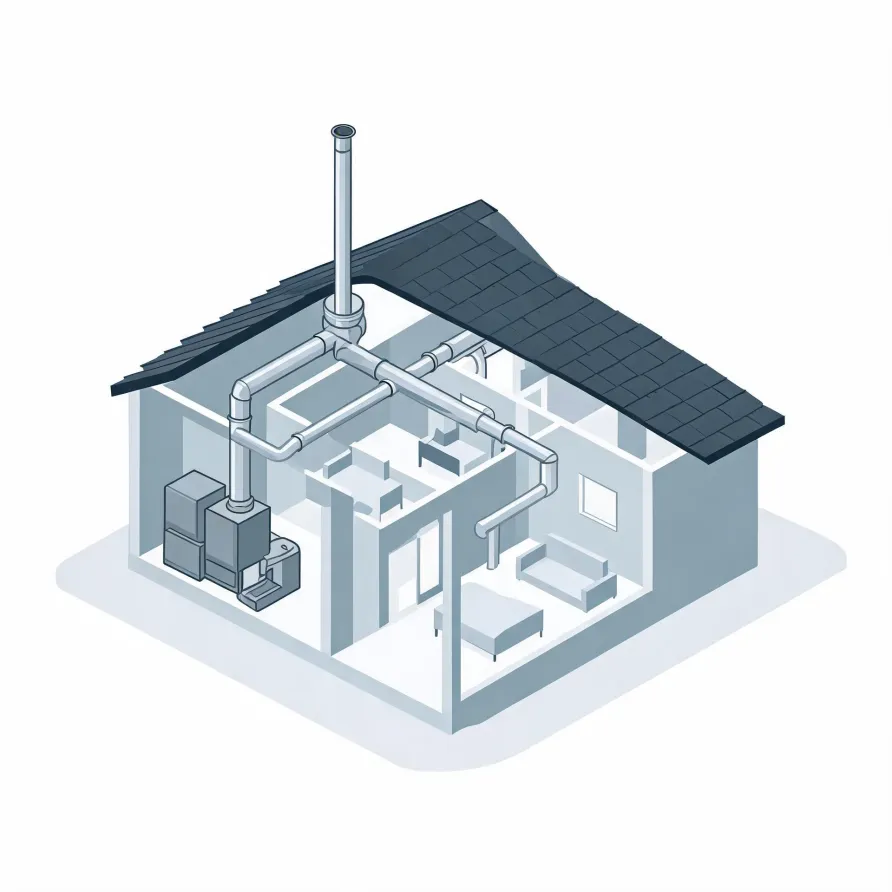
The heat exchanger sits inside the furnace cabinet, usually in a basement, utility closet, or mechanical room, and it is the piece most contractors look at early. Cracks or corrosion there can push combustion gases into living air. The burner assembly, just below it, is where the fuel ignites, and uneven flames or soot buildup are signs it needs attention.
The blower motor and its fan wheel sit at the base of the cabinet and move conditioned air out through the supply plenum. The draft inducer, near the flue outlet, pulls exhaust gases out of the heat exchanger before they can back up. The control board ties those components together, and a fault there can mimic symptoms that actually belong to something else.
The drawing shows a typical furnace layout, and a licensed contractor determines which components apply to the specific system and conditions in your home.
Find a contractor in Douglas CountyDouglas County, Missouri, by the numbers
233 severe weather events were recorded in Douglas County, Missouri between 2015 and 2024.
NOAA National Centers for Environmental Information, Storm Events Database, bulk CSV export, events 2015-01-01 through 2024-12-31.Half the homes in Douglas County, Missouri were built in 1987 or earlier (2020-2024 ACS 5-year).
U.S. Census Bureau, 2020-2024 American Community Survey 5-Year EstimatesDouglas County, Missouri holds 5,391 housing units (2020-2024 ACS 5-year).
U.S. Census Bureau, 2020-2024 American Community Survey 5-Year EstimatesOwners occupy 80.6% of the occupied homes in Douglas County, Missouri (2020-2024 ACS 5-year).
U.S. Census Bureau, 2020-2024 American Community Survey 5-Year EstimatesCodes & Standards Governing Furnace Repair in Douglas County, Missouri4 sourced rules & standards
What HVAC Repair Looks Like in Douglas County
Non-weatherized gas furnaces manufactured on or after November 19, 2015 must reach 80.0 percent AFUE.
Non-weatherized oil-fired furnaces manufactured on or after November 19, 2015 must reach 83.0 percent AFUE.
Mobile home gas furnaces manufactured on or after November 19, 2015 must reach 80.0 percent AFUE.
Non-weatherized gas furnaces manufactured on or after December 18, 2028 must reach 95.0 percent AFUE, up from the 80.0 percent minimum that applies to units manufactured before that date.
Severe Weather Events in Douglas County
Weather puts hours on heating equipment. Every hard weather event Douglas County records is a furnace working harder, longer, or under conditions it was not sized for on a calm day, and that wear is local, which is why a local contractor matters.
233 severe weather events, 2015–2024. Source: NOAA National Centers for Environmental Information, Storm Events Database.