Tell us about the job
Takes about a minute. No obligation.
Sizing a furnace for Butler County starts with how hard the burner and heat exchanger are going to work, not just how cold the worst days get. Homes in Butler County, MO run heat about seven months a year, from October through April. A heat exchanger that cycles through that many months of repeated firing and cooling accumulates fatigue in ways a contractor can measure at installation time by getting the load calculation right. Undersizing cuts into those margins immediately: the burner runs longer per cycle, the ignition system trips more often, and the heat exchanger carries stress it was not rated to handle. A contractor who quotes without running those numbers first is guessing at a system that will spend most of the year proving them wrong.
Existing ductwork is what a furnace installation turns on in this county, and the reason is in the housing stock itself. Half the homes in Butler County, Missouri were built in 1981 or earlier (2020-2024 ACS 5-year). Ductwork laid for an earlier generation of heating equipment was sized around different airflow and static pressure than a modern furnace produces. If a contractor installs a new unit without checking whether the existing duct system will carry it, the result is a furnace that runs but delivers poorly. The electrical service in a house of this vintage also gets measured before the quote is final, because what the new equipment draws has to match what the panel can supply.
What Gets Installed With a New Furnace
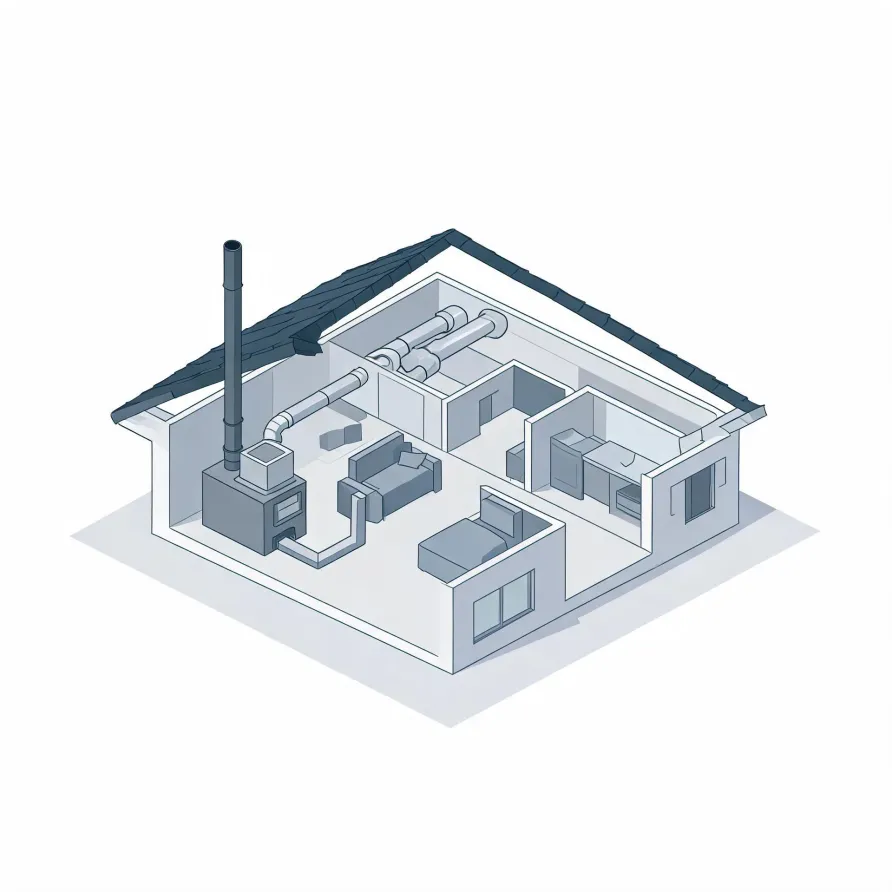
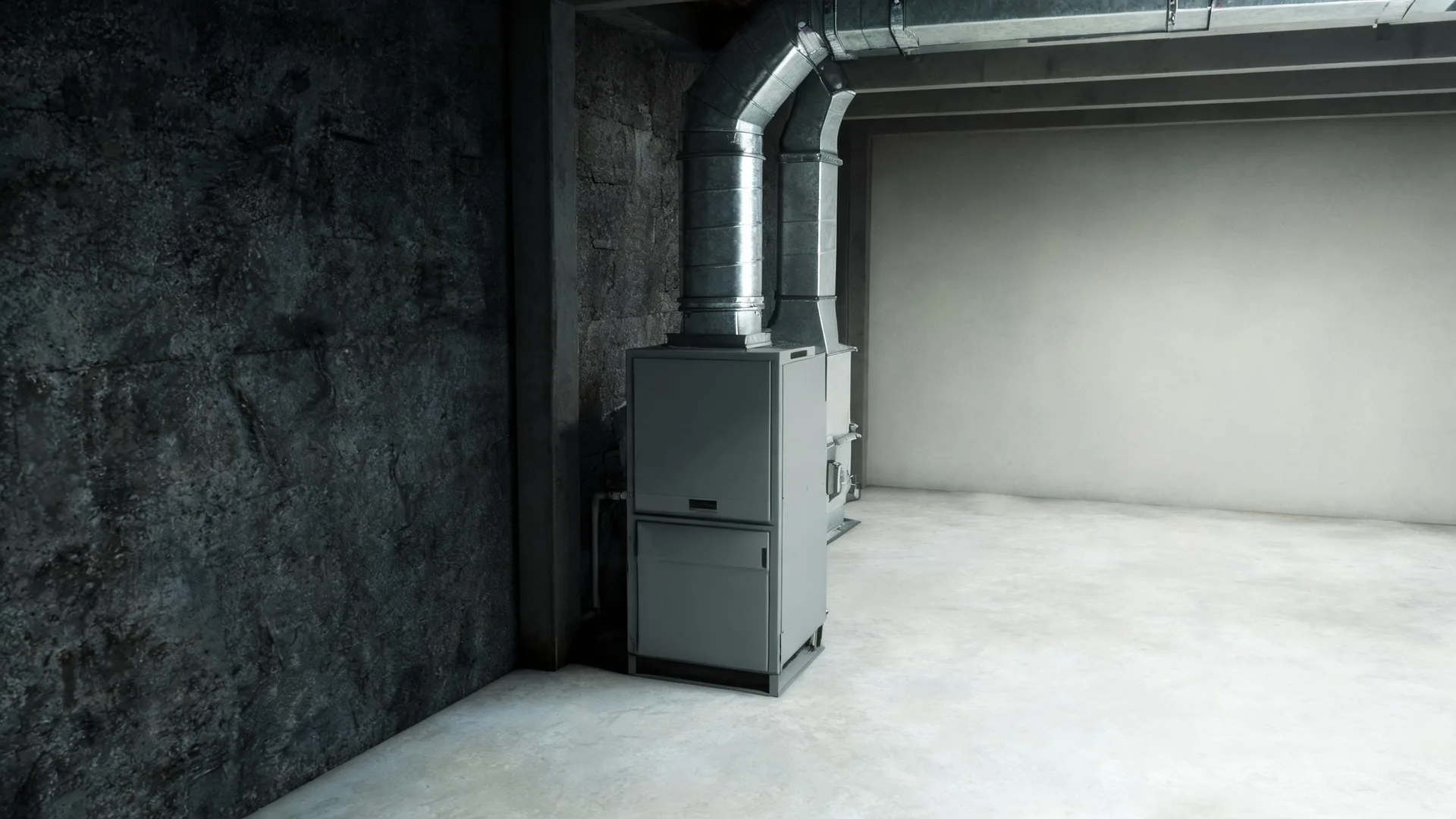
The furnace itself sits in a utility space, basement, or closet near the center of the house. It is the box that produces the heat. Inside it, a burner assembly and a heat exchanger do that work, and a blower motor pushes the warmed air out into the ducts. The flue pipe runs from the furnace to an exterior wall or roof and carries combustion exhaust out of the house.
The thermostat mounts on a living-area wall and is the control point for the whole system. A contractor also installs the gas supply line connection at the furnace and, on most new units, a condensate drain line that carries moisture produced by the combustion process to a floor drain or utility sink.
The drawing shows the general layout of a furnace system, and a licensed contractor determines exactly which components and configurations apply to your home.
Get matched in Butler CountyButler County, by the numbers
152 severe weather events were recorded in Butler County, Missouri between 2015 and 2024.
NOAA National Centers for Environmental Information, Storm Events Database, bulk CSV export, events 2015-01-01 through 2024-12-31.Half the homes in Butler County, Missouri were built in 1981 or earlier (2020-2024 ACS 5-year).
U.S. Census Bureau, 2020-2024 American Community Survey 5-Year EstimatesButler County, Missouri holds 19,303 housing units (2020-2024 ACS 5-year).
U.S. Census Bureau, 2020-2024 American Community Survey 5-Year EstimatesOwners occupy 64.6% of the occupied homes in Butler County, Missouri (2020-2024 ACS 5-year).
U.S. Census Bureau, 2020-2024 American Community Survey 5-Year EstimatesCodes & Standards Governing Furnace Installation in Butler County, Missouri4 sourced rules and standards
What the Installation Actually Looks Like
Non-weatherized gas furnaces manufactured on or after November 19, 2015 must reach 80.0 percent AFUE.
Non-weatherized oil-fired furnaces manufactured on or after November 19, 2015 must reach 83.0 percent AFUE.
Mobile home gas furnaces manufactured on or after November 19, 2015 must reach 80.0 percent AFUE.
Non-weatherized gas furnaces manufactured on or after December 18, 2028 must reach 95.0 percent AFUE, up from the 80.0 percent minimum that applies to units manufactured before that date.
Severe Weather Events in Butler County
Weather conditions drive how hard heating equipment works and how long it lasts. What happens in Butler County shapes the sizing and installation decisions a contractor makes for any home here.
152 severe weather events, 2015–2024. Source: NOAA National Centers for Environmental Information, Storm Events Database.