Tell us about the job
Takes about a minute. No obligation.
Getting the furnace size right matters more in Stoddard County than a contractor who works warmer markets might expect. Homes in Stoddard County, MO run heat about seven months a year, from October through April. A burner and heat exchanger that cycle through that many months accumulate wear that a short season would spread across far fewer start-stop cycles, and an undersized unit runs longer per cycle to keep up, which accelerates that wear further. A contractor quoting a new installation here has to run a proper load calculation first, because a box that is too small shows its limits fast, and one that is too large short-cycles and never fully conditions the air.
Ductwork sized for a different generation of equipment is what a contractor has to evaluate before a furnace installation in Stoddard County can be priced correctly. Half the homes in Stoddard County, Missouri were built in 1976 or earlier (2020-2024 ACS 5-year). Ducts laid out for an earlier system were designed around different airflow demands, and a new furnace running through them can lose much of its rated output to pressure drop or uneven distribution. The electrical service carries the same question: what the panel was built to handle and what a new unit actually draws may not match. Those two things, the duct layout and the electrical capacity, are what decide how the job goes here.
What Gets Installed With a New Furnace
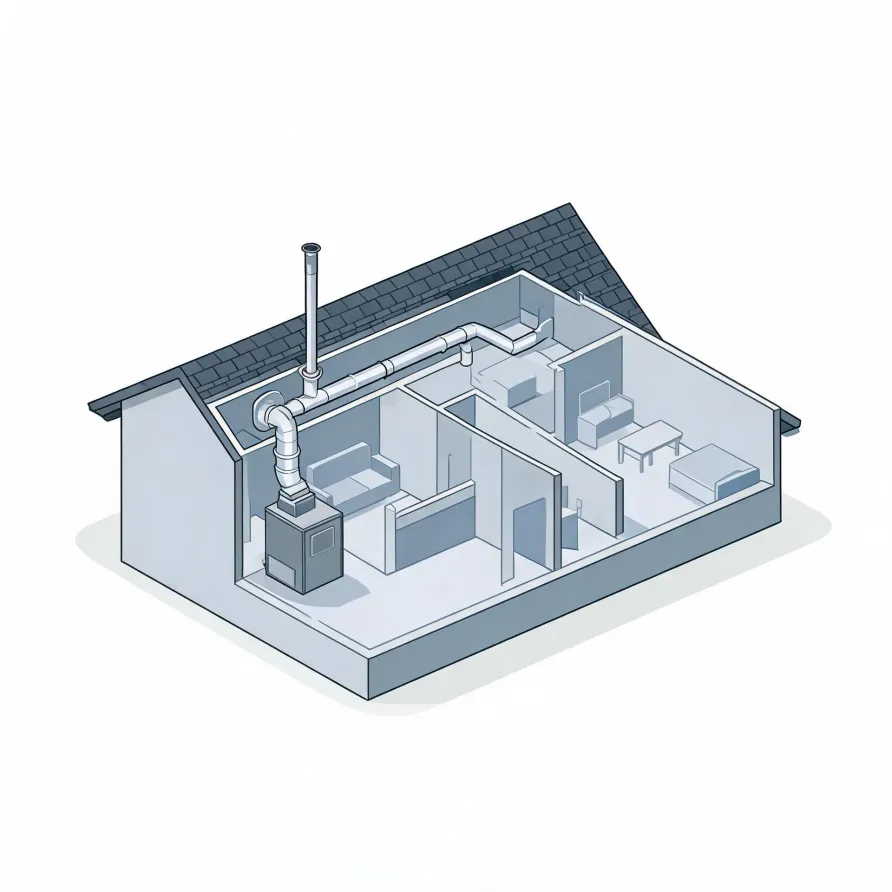
The furnace itself sits in the basement, utility room, or closet and is the piece that produces the heat. A burner assembly inside the cabinet burns fuel to generate that heat, and a heat exchanger transfers it to the air moving through. The blower motor, also inside the cabinet, pushes that warmed air out into the house.
The flue pipe runs from the furnace to an exterior wall or up through the roof, carrying combustion gases out of the living space. Alongside the furnace, a contractor installs the air filter housing, the gas supply line connection, and the thermostat that controls the whole system from inside the home.
The drawing shows the general layout of these components, and a licensed contractor determines what applies to the specific configuration of your house.
Get matched in Stoddard CountyStoddard County by the Numbers
143 severe weather events were recorded in Stoddard County, Missouri between 2015 and 2024.
NOAA National Centers for Environmental Information, Storm Events Database, bulk CSV export, events 2015-01-01 through 2024-12-31.Half the homes in Stoddard County, Missouri were built in 1976 or earlier (2020-2024 ACS 5-year).
U.S. Census Bureau, 2020-2024 American Community Survey 5-Year EstimatesStoddard County, Missouri holds 13,400 housing units (2020-2024 ACS 5-year).
U.S. Census Bureau, 2020-2024 American Community Survey 5-Year EstimatesOwners occupy 71.8% of the occupied homes in Stoddard County, Missouri (2020-2024 ACS 5-year).
U.S. Census Bureau, 2020-2024 American Community Survey 5-Year EstimatesFurnace Installation Rules on the Books for Stoddard County, Missouri4 sourced standards and codes
What HVAC Installation Looks Like in Stoddard County
Non-weatherized gas furnaces manufactured on or after November 19, 2015 must reach 80.0 percent AFUE.
Non-weatherized oil-fired furnaces manufactured on or after November 19, 2015 must reach 83.0 percent AFUE.
Mobile home gas furnaces manufactured on or after November 19, 2015 must reach 80.0 percent AFUE.
Non-weatherized gas furnaces manufactured on or after December 18, 2028 must reach 95.0 percent AFUE, up from the 80.0 percent minimum that applies to units manufactured before that date.
Severe Weather Events in Stoddard County
Weather here puts real load on heating equipment, and that load shapes what a furnace needs to handle over its life. A contractor sizing or installing a unit in Stoddard County works from local conditions, not averages.
143 severe weather events, 2015–2024. Source: NOAA National Centers for Environmental Information, Storm Events Database.