Tell us about the job
Takes about a minute. No obligation.
A furnace repair in Andrew County starts with the parts that cycle the most. Homes in Andrew County, MO run heat about seven months a year, from October through April. Burners, igniters, and heat exchangers absorb that cycling directly, and those are the components a contractor checks before anything else when a furnace stops performing. A cracked heat exchanger or a worn igniter is the likeliest story. Ductwork and controls get attention too, but the combustion side is where the load lands.
Furnace parts fail in ways that reflect the system's history, and in Andrew County that history runs deep. Half the homes in Andrew County, Missouri were built in 1980 or earlier (2020-2024 ACS 5-year). A house that has cycled through at least one full heating system since it was built carries wear in places a new owner may not expect: heat exchanger stress, burner tolerances that have drifted, and flue paths that were fitted to something no longer there. When a contractor opens a furnace here, the question is whether the replacement parts that unit now requires are still in production, and whether the repair addresses what actually failed or only what is visible from the outside.
The Parts of a Furnace a Contractor Checks First
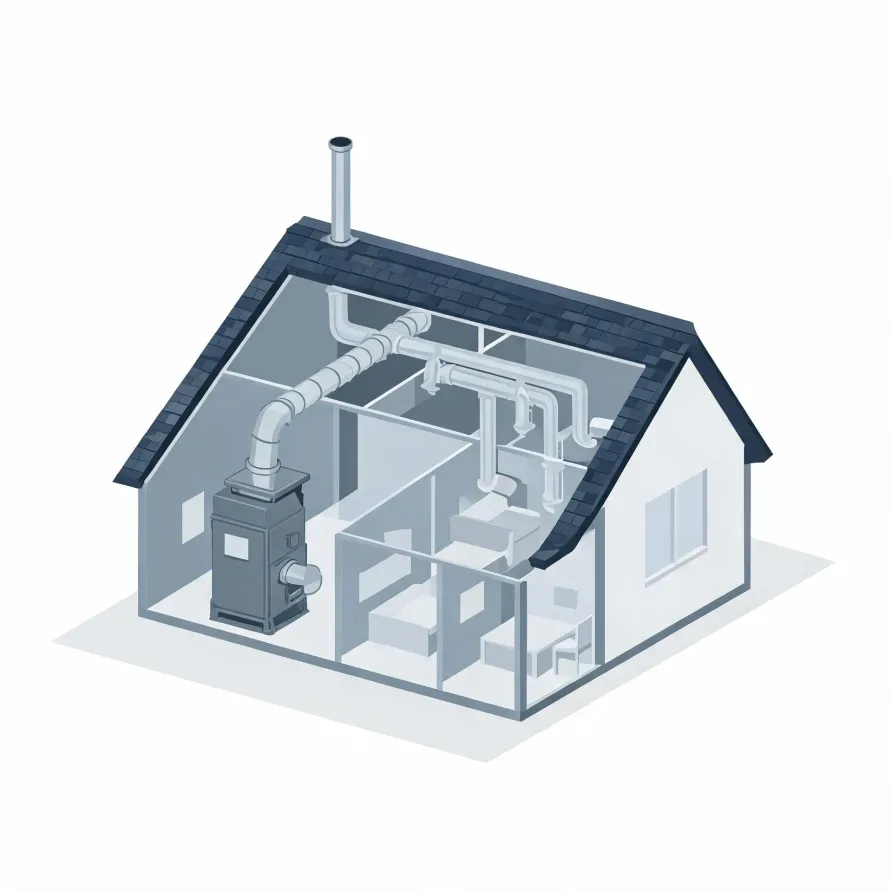
The furnace itself sits in a utility area, basement, or closet and is the piece a contractor goes to first. Inside it, the heat exchanger is the part most likely to be behind a no-heat call, and the burners, igniter, and flame sensor sit close together, so a problem in one of them usually shows up fast during inspection.
The blower motor and its wheel live in the lower cabinet and push conditioned air into the supply ducts. The flue pipe runs from the top of the unit to an exterior vent, and the condensate drain on high-efficiency units sits nearby. A contractor checks both for blockages that can shut the system down.
The drawing shows a general layout of these components, and a licensed contractor determines which parts apply and what they find in your specific home.
Find a contractor in Andrew CountyAndrew County, by the numbers
46 severe weather events were recorded in Andrew County, Missouri between 2015 and 2024.
NOAA National Centers for Environmental Information, Storm Events Database, bulk CSV export, events 2015-01-01 through 2024-12-31.Half the homes in Andrew County, Missouri were built in 1980 or earlier (2020-2024 ACS 5-year).
U.S. Census Bureau, 2020-2024 American Community Survey 5-Year EstimatesAndrew County, Missouri holds 7,558 housing units (2020-2024 ACS 5-year).
U.S. Census Bureau, 2020-2024 American Community Survey 5-Year EstimatesOwners occupy 76.7% of the occupied homes in Andrew County, Missouri (2020-2024 ACS 5-year).
U.S. Census Bureau, 2020-2024 American Community Survey 5-Year EstimatesCodes & Standards Covering Furnace Repair in Andrew County, Missouri4 sourced rules and standards
What HVAC Repair Looks Like in Andrew County
Non-weatherized gas furnaces manufactured on or after November 19, 2015 must reach 80.0 percent AFUE.
Non-weatherized oil-fired furnaces manufactured on or after November 19, 2015 must reach 83.0 percent AFUE.
Mobile home gas furnaces manufactured on or after November 19, 2015 must reach 80.0 percent AFUE.
Non-weatherized gas furnaces manufactured on or after December 18, 2028 must reach 95.0 percent AFUE, up from the 80.0 percent minimum that applies to units manufactured before that date.
Severe Weather Events in Andrew County
Hard weather puts real hours on furnace equipment. The strain that builds up during rough stretches is why repair needs in Andrew County are not the same as they are somewhere with a milder record.
46 severe weather events, 2015–2024. Source: NOAA National Centers for Environmental Information, Storm Events Database.