Tell us about the job
Takes about a minute. No obligation.
On a repair call in Newton County, a contractor looks at the burner assembly and heat exchanger before tracing anything else, because those are the parts that absorb the full weight of the heating season's cycling. Homes in Newton County, MO run heat about seven months a year, from October through April. The igniter, the heat exchanger seams, and the burner ports all accumulate wear in direct proportion to how many months they run, and a long heating season gives a marginal part less idle time to hide behind. Cracks in a heat exchanger that might not show up until year eight in a milder climate can surface earlier here.
Furnaces running in houses this old have usually been through at least one replacement cycle, which means the unit a contractor opens may share almost nothing with the ductwork and wiring around it. Half the homes in Newton County, Missouri were built in 1984 or earlier (2020-2024 ACS 5-year). That gap is where furnace repair gets complicated: a heat exchanger or control board pulled out of a system this vintage may still be available, or it may take sourcing, and a contractor has to confirm that before the repair scope is settled. What the opened unit turns out to contain sets the direction of the job.
The Parts of a Furnace a Contractor Checks First
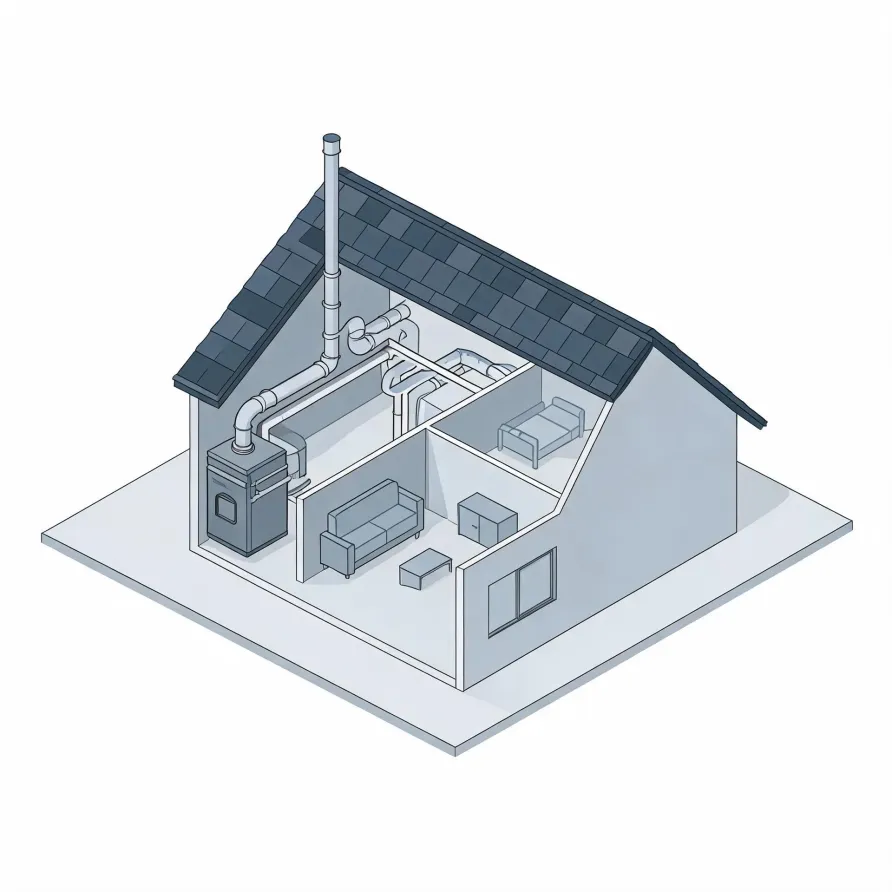
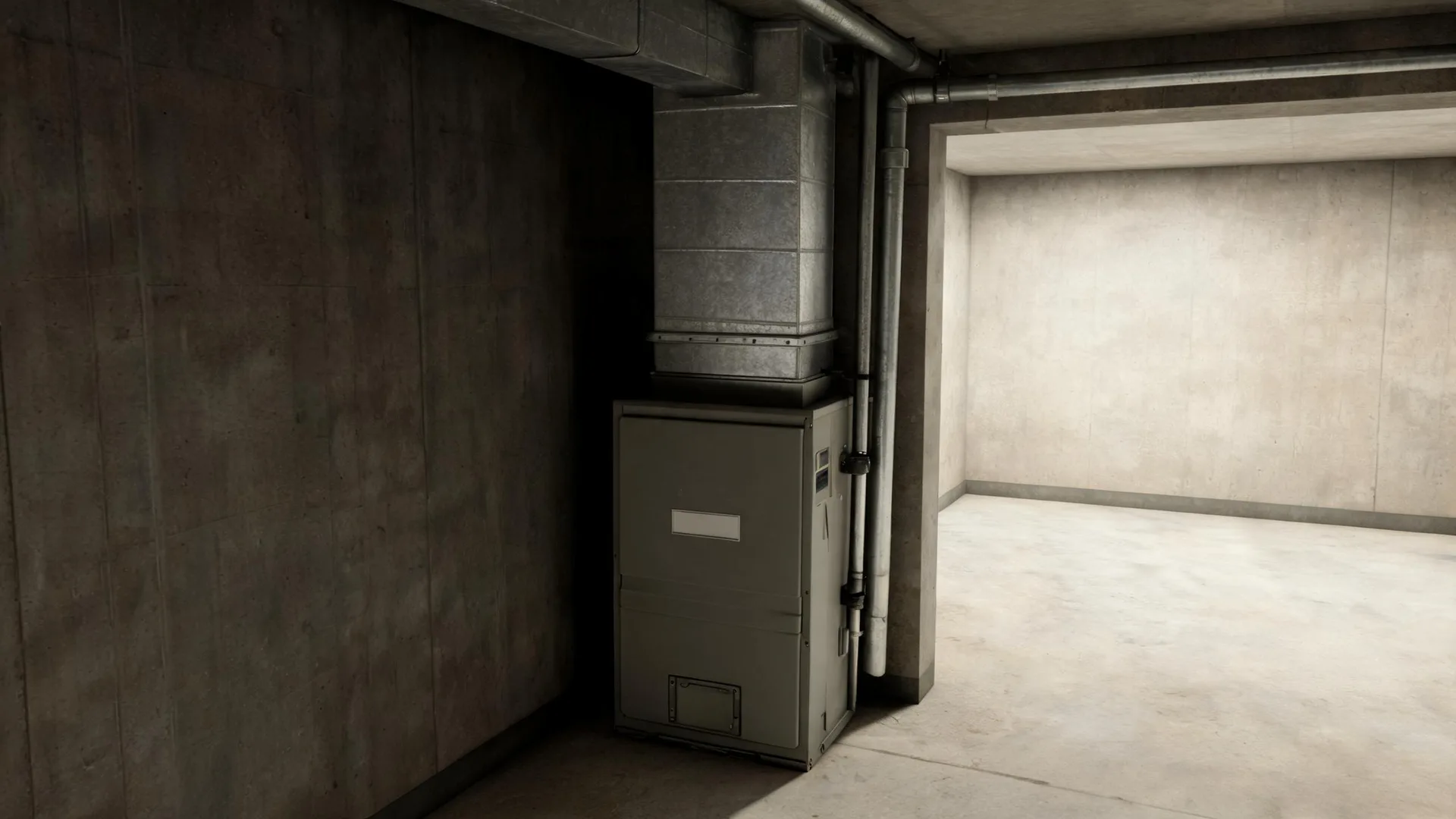
The furnace itself sits in the basement, utility room, or closet and is the piece a contractor goes to first. Inside it, the heat exchanger is the part that does the actual work of warming air, and a crack or failure there is one of the more serious faults a contractor looks for. The burners, which fire inside that exchanger, and the igniter, which lights them, are frequent starting points when a furnace fails to produce heat at all.
The blower motor and its fan wheel sit inside the furnace cabinet and push conditioned air out into the house. The flue pipe runs from the cabinet up and out of the building, and a contractor checks it because a blocked or separated flue affects both combustion and safety. The thermostat on the wall is the control side of the system, and a wiring or calibration fault there can mimic a furnace problem.
The drawing shows the general layout of these components, and a licensed contractor determines what applies to your specific house and equipment.
Get matched in Newton CountyNewton County, by the numbers
219 severe weather events were recorded in Newton County, Missouri between 2015 and 2024.
NOAA National Centers for Environmental Information, Storm Events Database, bulk CSV export, events 2015-01-01 through 2024-12-31.Half the homes in Newton County, Missouri were built in 1984 or earlier (2020-2024 ACS 5-year).
U.S. Census Bureau, 2020-2024 American Community Survey 5-Year EstimatesNewton County, Missouri holds 24,866 housing units (2020-2024 ACS 5-year).
U.S. Census Bureau, 2020-2024 American Community Survey 5-Year EstimatesOwners occupy 76.6% of the occupied homes in Newton County, Missouri (2020-2024 ACS 5-year).
U.S. Census Bureau, 2020-2024 American Community Survey 5-Year EstimatesCodes & Standards Behind Furnace Repair in Newton County, Missouri4 sourced rules and standards
What HVAC Repair Looks Like in Newton County
Non-weatherized gas furnaces manufactured on or after November 19, 2015 must reach 80.0 percent AFUE.
Non-weatherized oil-fired furnaces manufactured on or after November 19, 2015 must reach 83.0 percent AFUE.
Mobile home gas furnaces manufactured on or after November 19, 2015 must reach 80.0 percent AFUE.
Non-weatherized gas furnaces manufactured on or after December 18, 2028 must reach 95.0 percent AFUE, up from the 80.0 percent minimum that applies to units manufactured before that date.
Severe Weather Events in Newton County
Weather patterns in Newton County put real stress on heating equipment over time. That wear is local, and the repair work that follows it is local too.
219 severe weather events, 2015–2024. Source: NOAA National Centers for Environmental Information, Storm Events Database.